BUSINESS PROCESS MANAGEMENT

Found this helpful? Share it with peers.
Introduction
Process implementation is the structured execution of newly designed or improved business processes, ensuring that they are effectively adopted, operational, and continuously optimized within an organization. It represents the point where process design moves from theory into daily business reality.
In the context of Business Process Management (BPM), process implementation plays a critical role in transforming modeled “to-be” processes into executable workflows that deliver measurable business outcomes. Without a well-planned implementation phase, even well-designed processes fail to generate value.
Implementing new processes is not a one-time activity, but a coordinated effort involving people, governance, technology, and change management. Organizations must align stakeholders, clarify responsibilities, provide training, and monitor execution to ensure sustainable adoption.
This guide explains what process implementation is, how it fits into the BPM lifecycle, and which steps, success factors, and framework conditions are essential to implement business processes successfully.
What is process implementation?
Process implementation refers to the systematic execution and rollout of new or improved business processes, ensuring that process designs are operationalized, understood by stakeholders, supported by technology, and continuously monitored for performance and improvement.
Process Implementation in the Process Management Life Cycle (PMLC)
Within Business Process Management (BPM), process implementation is a core phase of the Process Management Life Cycle (PMLC). The PMLC provides a structured framework that guides organizations from identifying process improvement opportunities to executing and continuously optimizing business processes.
While earlier PMLC phases focus on analyzing and designing “to-be” processes, process implementation is the phase where these designs are translated into operational reality. It ensures that new or improved processes are adopted by the organization, supported by the right governance and technology, and embedded into daily operations.
In most BPM frameworks, process implementation follows the release of approved “to-be” processes and represents the transition from design to execution. This phase typically includes change management activities, training, system configuration, and performance monitoring to ensure sustainable process adoption.
Without a structured process implementation phase, BPM initiatives often fail to deliver measurable value — not because processes are poorly designed, but because they are not effectively executed.
To learn more about the PMLC framework, check out our blog post on Business Process Management. Or read up on our Process Documentation and Process Analysis blog posts for deeper insights into the first two phases.
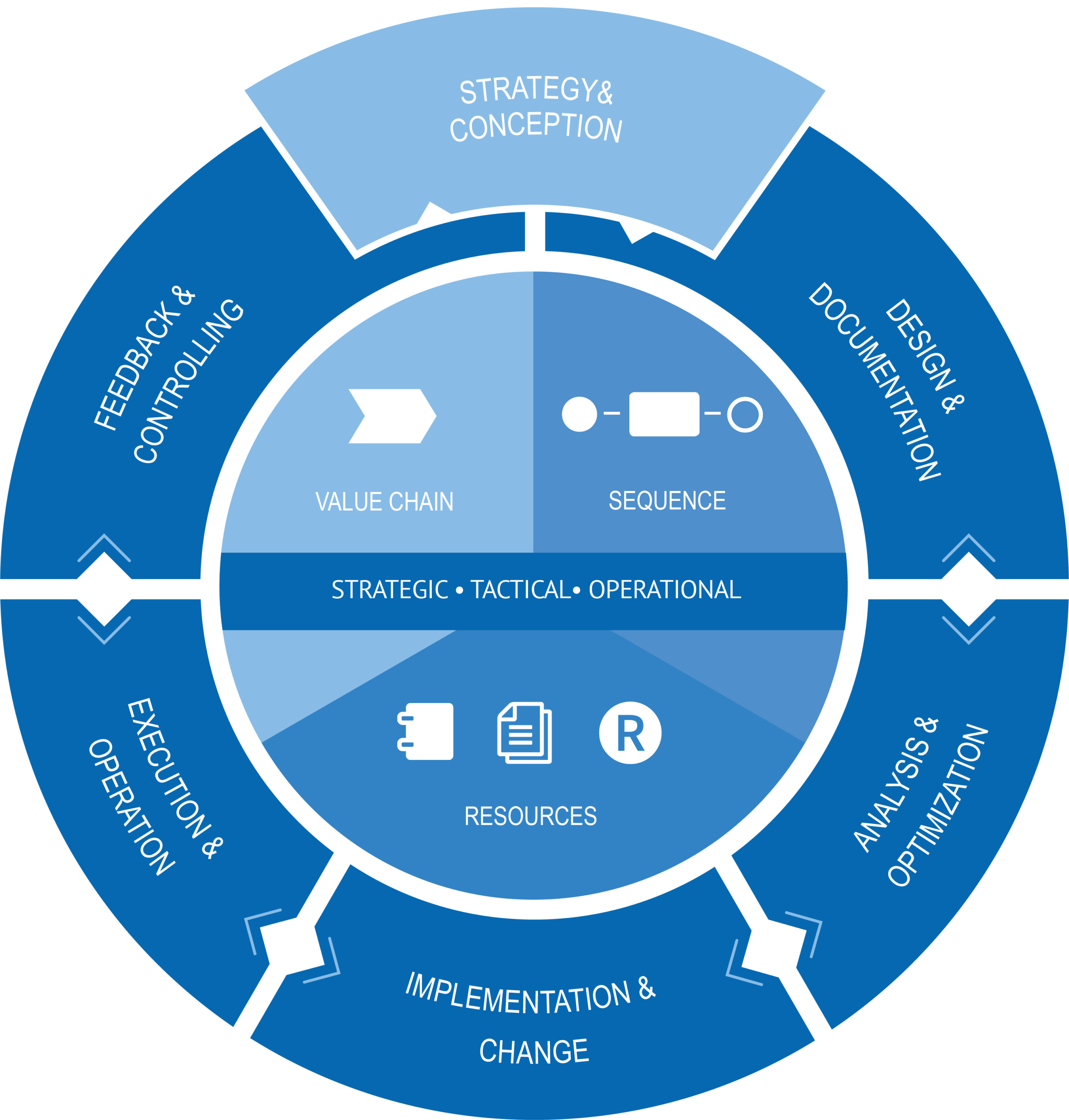
BOC Group’s Process Management Lifecycle (PMLC)
Why is process implementation important?
Process implementation is critical because it determines whether designed processes actually deliver value in daily operations. While process analysis and design define how work should be done, implementation ensures that this vision is consistently executed across the organization.
From a Business Process Management (BPM) perspective, effective process implementation directly impacts operational performance, governance, and organizational resilience. Without it, BPM initiatives remain theoretical and fail to produce measurable outcomes.
Operational consistency and transparency
Process implementation standardizes how work is executed, reducing ambiguity and ensuring that roles, responsibilities, and handovers are clearly defined. This transparency is essential for scalable operations and auditability.
Efficiency and performance improvement
Well-implemented processes reduce rework, manual coordination, and process cycle times. By defining clear execution paths, organizations can improve productivity while lowering operational costs.
Risk reduction and compliance
Structured process implementation ensures that controls, approvals, and compliance requirements are embedded directly into operational workflows. This minimizes operational risk and supports regulatory adherence.
Continuous improvement enablement
Only implemented processes can be monitored and measured. Process implementation creates the foundation for performance tracking, KPI monitoring, and data-driven process optimization within BPM.
Employee clarity and adoption
Clear and executable processes reduce uncertainty for employees. When people understand how and why processes work, resistance decreases and adoption increases — a key success factor in any BPM initiative.
Clear and executable processes reduce uncertainty for employees. When people understand how and why processes work, resistance decreases and adoption increases — a key success factor in any BPM initiative.
In short, process implementation is the bridge between process design and sustained business value. Organizations that invest in structured implementation outperform those that focus solely on modeling or documentation.
Process Implementation: A Structured BPM Framework
When focusing on process implementation, the most important steps will depend on the specific process or task that needs improvement. However, there are some general steps that can be useful when implementing any process:
Step 1: Identify and scope the process
The first step in process implementation is to clearly identify which process will be implemented and define its scope. This includes determining process boundaries, objectives, stakeholders, and success criteria.
-
Key output: defined process scope and objectives
-
Involved roles: process owner, subject matter experts
-
BPM focus: alignment with business goals
Step 2: Analyze the current state (as-is)
Before implementing a new or improved process, organizations must understand how work is currently performed. This involves documenting the existing process, identifying inefficiencies, risks, and dependencies, and collecting feedback from involved teams.
-
Key output: validated as-is process model
-
Involved roles: process analysts, operational teams
-
BPM focus: transparency and problem identification
.
Step 3: Design and validate the future state (to-be)
Based on the as-is analysis, a to-be process is designed to address identified gaps and improvement opportunities. Validation with stakeholders is critical to ensure feasibility, compliance, and acceptance.
-
Key output: approved to-be process model
-
Involved roles: process owner, compliance, IT
-
BPM focus: governance and design quality
Step 4: Prepare the organization for change
Process implementation requires organizational readiness. This step focuses on communication, training, and stakeholder engagement to ensure that all affected parties understand the upcoming changes and their responsibilities.
-
Key output: change and communication plan
-
Involved roles: change management, HR, line managers
-
BPM focus: adoption and risk reduction
Step 5: Execute and operationalize the process
This step represents the actual rollout of the process into daily operations. It may include system configuration, workflow execution, documentation updates, and performance tracking setup.
-
Key output: operational process in production
-
Involved roles: operations, IT, process owner
-
BPM focus: execution consistency
Step 6: Monitor performance and continuously improve
Once implemented, processes must be monitored using defined KPIs. Feedback and performance data are used to identify optimization opportunities and trigger continuous improvement cycles within BPM through process monitoring.
-
Key output: performance insights and improvement actions
-
Involved roles: process owner, management, controlling
-
BPM focus: continuous improvement

Framework Conditions That Determine Process Implementation Success
Successful process implementation depends not only on process design quality, but on a set of organizational framework conditions that directly influence adoption, execution, and long-term sustainability.
These conditions define whether a process can be implemented effectively across the organization — or whether it will remain a theoretical model without real operational impact.
- Economic framework conditions
The available budget and resource allocation determine the scope, speed, and depth of process implementation. Organizations must ensure that sufficient financial resources are allocated not only for initial rollout, but also for training, tooling, and ongoing optimization.
Risk if ignored: incomplete implementation, stalled initiatives, low adoption.
- Organizational framework conditions
Organizational structure, decision-making authority, and governance models strongly influence process implementation. Clear ownership, escalation paths, and accountability are essential to ensure consistent execution across departments.
Risk if ignored: fragmented execution, conflicting responsibilities, process deviations.
- Technical framework conditions
Process implementation must consider existing IT landscapes, system integration capabilities, and automation readiness. Processes that are not technically supported quickly degrade into manual workarounds.
Risk if ignored: inefficiency, shadow processes, loss of control.
- Cultural and sociological framework conditions
Corporate culture plays a decisive role in how change is perceived and adopted. Openness to change, transparency, and trust influence whether employees follow new processes or resist them.
Risk if ignored: resistance to change, informal process execution.
- Personal framework conditions
Individual experience, skills, and mindset of employees directly affect process adoption. Training, enablement, and involvement are critical to ensure that people can execute processes as designed.
Risk if ignored: execution errors, dependency on individuals, low process maturity.
Key Success Factors for Effective Process Implementation
Considering all these framework conditions, the following success factors, are crucial for a successful process implementation:
Clear identification of stakeholders
Successful process implementation starts with a clear understanding of who is affected and how. Different stakeholder groups require different levels of information, involvement, and responsibility.
Why it matters: misaligned stakeholders are the fastest way to implementation failure.
Appropriate timing and sequencing
Implementation timing must align with organizational capacity, operational cycles, and strategic priorities. Implementation schedules should be reviewed continuously and adjusted when necessary.
Why it matters: poor timing creates resistance and overload.
Defined roles and responsibilities
Process implementation initiatives require clear ownership, typically involving a process owner, project manager, and implementation team. Responsibilities must be unambiguous to avoid execution gaps.
Why it matters: unclear ownership leads to stalled decisions and inconsistent execution.
Structured involvement and communication
Information, communication, and participation must be deliberately designed. Employees need to understand what is changing, why it is changing, and how it affects their work.
Why it matters: participation increases acceptance and process adherence.
Appropriate communication channels and media
The choice of communication channels should reflect organizational culture and context. The goal is not maximum communication, but effective communication at the right time.
Why it matters: wrong channels reduce message impact.
Continuous feedback and interaction
Feedback loops allow organizations to identify implementation issues early and adjust processes accordingly. Employees executing the process daily provide the most valuable insights.
Why it matters: feedback is essential for sustainable improvement.

Benefits of a successful process implementation
A successful process implementation creates measurable business value by transforming process designs into executable, repeatable, and controllable operations. It ensures that processes are not only documented, but consistently applied and continuously improved across the organization.
Operational efficiency and scalability
Implemented processes reduce rework, manual coordination, and dependency on individual knowledge. This improves productivity, shortens process cycle times, and enables scalable operations as organizational complexity increases.
Risk management and control effectiveness
Process implementation embeds controls, approvals, and escalation mechanisms directly into operational workflows. This reduces operational risk, increases process reliability, and strengthens internal control effectiveness.
Quality and consistency
Standardized process execution minimizes variation in how work is performed. This improves output quality, supports quality management initiatives, and reduces errors and deviations.
Customer experience and service performance
Clear execution paths and defined responsibilities reduce delays, handover friction, and service inconsistencies. This leads to improved responsiveness and a more reliable customer experience.
Strategic alignment and execution
Well-implemented processes translate strategic objectives into day-to-day operations. This improves accountability, supports decision-making, and ensures that strategic initiatives are consistently executed.
Financial performance and cost transparency
Structured process execution improves cost control and budgeting accuracy. By reducing inefficiencies and rework, organizations gain better visibility into process-related costs and financial performance.
Cross-functional and supply chain coordination
Process implementation clarifies interfaces between departments and external partners. This improves collaboration, reduces coordination breakdowns, and supports smoother end-to-end process execution.
Compliance and audit readiness
Clearly implemented processes increase transparency, traceability, and documentation quality. This supports regulatory compliance, internal audits, and consistent adherence to organizational policies.
Who should be involved in implementing processes?
Effective process implementation requires clearly defined roles and responsibilities. While the exact setup depends on organizational size and complexity, the following roles are essential to ensure successful execution and sustainable adoption.
- Process owner
The process owner is accountable for the end-to-end performance of the process. This role ensures alignment with business objectives, resolves escalations, and takes ownership of process outcomes after implementation.
Why this role matters: without clear ownership, processes degrade quickly after rollout.
Process Implementation / Change Management Team
This team is responsible for planning and coordinating implementation activities, including communication, training, and stakeholder engagement. They manage resistance and ensure organizational readiness.
Why this role matters: implementation fails without structured change management.
IT / Technology Team
The IT team supports process implementation by configuring systems, enabling integrations, and ensuring technical feasibility. Their involvement is critical when processes are supported by BPM or workflow tools.
Why this role matters: poorly supported processes lead to manual workarounds and loss of control.
Operations / Execution Teams
These teams execute the process in daily operations. Their feedback is essential to validate process feasibility and identify improvement opportunities.
Why this role matters: processes succeed or fail where they are executed.
Management and Leadership
Senior management provides strategic direction, prioritization, and visible sponsorship. Their support legitimizes change and reinforces the importance of process adherence.
Why this role matters: lack of leadership support is a common root cause of implementation failure.
Summary
Process implementation is a critical phase within Business Process Management that determines whether designed processes deliver real business value. It translates process models into operational reality by aligning people, governance, and technology.
Successful process implementation requires more than execution. It depends on clear ownership, organizational readiness, effective change management, and continuous performance monitoring. When implemented systematically, processes become transparent, scalable, and continuously improvable.
Organizations that invest in structured process implementation create the foundation for operational excellence, risk control, and sustainable business performance within BPM — supported by tools like the ADONIS BPM Software.





Already got our weekly updates?